

From the Ecocide of the Tren Maya to the Chinese Mafia: Biodiversity as a Currency in the Fentanyl Trade?
Because the Maya Train is a business—just not for Mexicans
Eloina Viveros G.
10/10/20248 min read
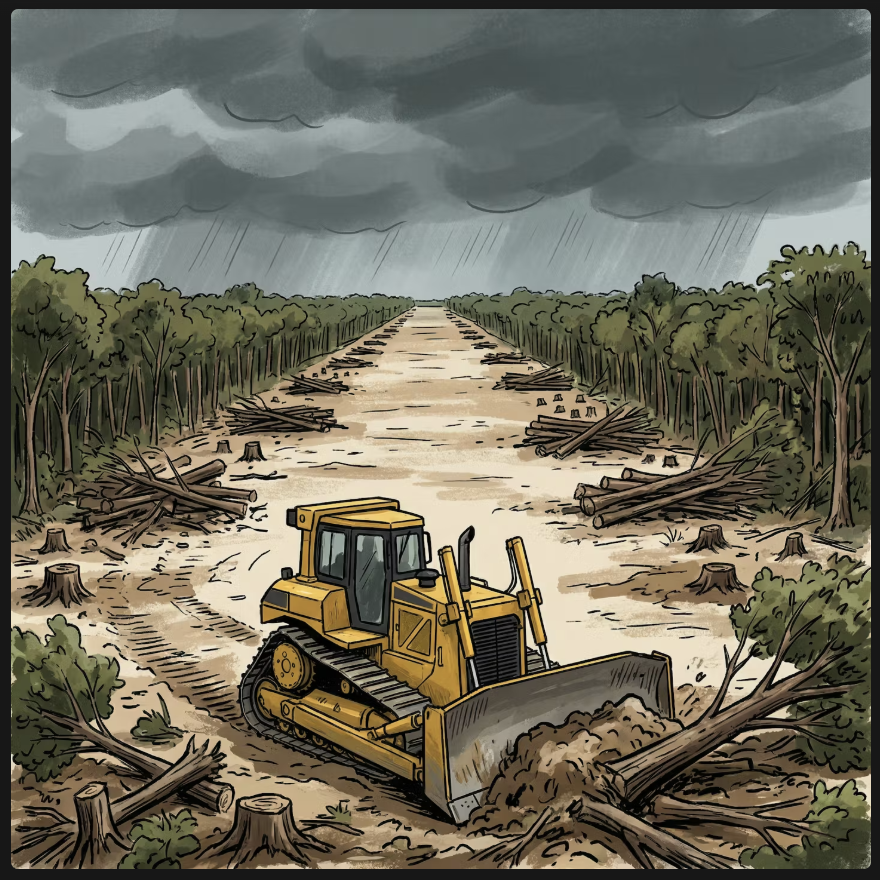
The idea that has been sold about the Maya Train is nothing more than an illusion presented as development, progress, and national sovereignty; however, it is the façade of a complex web of criminal business dealings between international mafias.
Behind the official discourse, the Maya Train is not just a railway megaproject: it is a documented ecocide, a multibillion-dollar business, and yet another link in a transnational network of corruption and organized crime that connects Mexico with the Chinese mafia through illegal timber trafficking, the global market for synthetic drugs such as fentanyl, and the laundering of money generated by illicit businesses.
Devastation that does not match the discourse
By February 2023, the federal government itself acknowledged the logging or removal of 3,444,000 trees for the Maya Train works, according to information published by Animal Político based on data from FONATUR (1). However, civil society organizations, academics, and legislators estimate that the real figure exceeds 12 million trees felled. The territorial impact confirms that these are not “minor adjustments.” The Maya Train cartographic tool, based on satellite evidence and developed by CartoCrítica (2), documents 6,659 hectares completely deforested and 10,831 hectares impacted in total. To put this into perspective: an area equivalent to ten times Chapultepec Forest or twenty times Central Park (3). Even more serious, 87% of the deforested areas lacked authorisation for a change in forest land use (4), which constitutes a federal crime under the Criminal Code.
This is compounded by the dispossession of peasant and Indigenous communities, often forced to sell their land at derisory prices to facilitate the project’s advance. The uncomfortable question is: where is the wood?. When the Ministry of Environment was questioned in December 2023 about the destination of the extracted timber, the response was alarming: officially, there was no answer (5). A significant portion of this wood corresponds to precious species such as cedar, mahogany, granadillo, and rosewood, the latter protected under the Convention on International Trade in Endangered Species of Wild Fauna and Flora (6).
In June 2021, the Office of the Fiscalía General de la República seized a shipment of rosewood valued at more than 3 million dollars at Puerto Progreso (7), destined for China. The final whereabouts of the containers remain uncertain, as according to Acción Civil Mexicana, after a second expert assessment and alleged bribes, it was determined that the wood was not precious timber, and Chinese lawyers recovered the shipment (14).
Mexico, China, and the criminal economy
According to Vanda Felbab-Brown, a researcher at the Brookings Institution, Mexico and China have for years maintained an informal collaboration in the illegal trafficking of flora, fauna, and synthetic drugs, including fentanyl and other opioids (8).
The Chinese mafia—particularly networks linked to the Triads—plays a central role in laundering money for Mexican organised crime, using financial triangulation schemes that connect currency exchange houses, shell companies, international transfers, and ostensibly legal trade. Recent investigations by the Financial Times document how these Chinese networks have perfected transnational laundering systems, allowing profits from Mexican cartels to return to Asia through circuits parallel to the traditional financial system, making them difficult for authorities to trace (9).
This phenomenon is not new: the Drug Enforcement Administration (DEA) had already warned in its 2017 National Drug Threat Assessment that Chinese intermediaries were operating as key actors in the fentanyl supply chain, both in the provision of chemical precursors and in the movement and laundering of illicit capital (10). Added to this is a report by the Central European Institute of Asian Studies (11), which has documented the structural presence of Chinese criminal networks in Mexico, their adaptation to local illicit economies, and their interaction with Mexican organized crime actors in schemes involving money laundering, smuggling, and transnational illegal trade. The power of these organizations has been such that, as documented by ProPublica, Chinese triads have transformed the global dynamics of money laundering, displacing traditional methods and offering cartels highly efficient, fast, and difficult-to-trace financial services (11). What is new is their incursion into the illicit trafficking of natural resources such as illegal timber and other goods of illicit origin that function as currency of exchange, deepening environmental devastation in Mexico. Neither Mexico nor China has signed a solid international treaty against this illicit trade. Both countries prefer the discretion of “case-by-case” handling.
The Global Organized Crime Index classifies Mexico as a country with high levels of organized crime and corruption embedded within the State, where officials at different levels facilitate criminal activities. Under these conditions, illegal timber trafficking has become a highly lucrative industry, associated with violence, forced disappearances, and territorial control (12).
Animal Político. Árboles talados y removidos por obras del Tren Maya superan los 3 millones, reconoce el gobierno.
https://animalpolitico.com/politica/arboles-talados-removidos-obras-tren-maya-gobiernoCartoCrítica. Tren Maya: cartografía de la devastación.
https://trenmaya.cartocritica.org.mx/Mongabay Latam. México: organizaciones denuncian deforestación por el Tren Maya.
https://es.mongabay.com/2023/08/mexico-organizaciones-denuncian-deforestacion-por-tren-maya/CartoCrítica. Tren Maya: Análisis de la deforestación y gestión forestal.
https://cartocritica.org.mx/2023/tren-maya-analisis-de-la-deforestacion-y-gestion-forestal/Reclaman destino de diez millones de árboles maderables por tala para dar paso al Tren Maya https://www.cronica.com.mx/nacional/reclaman-destino-diez-millones-arboles-maderables-tala-dar-paso-tren-maya.html
Acción Civil Mexicana. Tren Maya: ecocidio, despilfarro y corrupción.
https://accioncivilmexicana.org/tren-maya-ecocidio-despilfarro-y-corrupcionVale 3 mdd madera fina asegurada en Yucatán que iba ilegalmente a China https://www.tvazteca.com/aztecanoticias/fgr-decomisa-madera-valuada-en-mas-de-3-mdd-que-iba-a-china-scol
Vanda Felbab-Brown, Brookings Institution. Análisis sobre crimen organizado transnacional y vínculos entre México y China. https://www.forbes.com/sites/nathanielparishflannery/2022/02/23/how-is-china-tied-to-organized-crime-in-mexico/
Financial Times. How Chinese money brokers help Mexican cartels launder billions.
https://www.ft.com/content/acaf6a57-4c3b-4f1c-89c4-c70d683a6619U.S. Drug Enforcement Administration (DEA). 2017 National Drug Threat Assessment.
https://www.dea.gov/sites/default/files/2018-07/DIR-040-17_2017-NDTA.pdfCentral European Institute of Asian Studies (CEIAS). China’s Criminal Networks in Mexico.
https://ceias.eu/wp-content/uploads/2020/06/Mexico_FINAL.pdfProPublica. How Chinese crime groups are transforming global money laundering.
https://www.propublica.org/article/china-cartels-xizhi-li-money-launderingGlobal Initiative Against Transnational Organized Crime. Global Organized Crime Index – Mexico. https://ocindex.net/country/mexico
La Mafia de la Madera en la Selva Maya https://www.nmas.com.mx/nacional/la-mafia-de-la-madera-en-la-selva-maya/
InSight Crime. Illegal logging, armed groups and environmental crime in the Maya Biosphere Reserve.
https://insightcrime.org/investigations/jungle-patrol-fighting-illegal-loggers-guatemala-mexico-border/Diario Oficial de la Federación 18 de mayo de 2023 https://www.dof.gob.mx/index_113.php?year=2023&month=05&day=18#gsc.tab=0
Información corporativa y de contratos públicos sobre participación de fondos de inversión (BlackRock, Vanguard) y en megaproyectos de infraestructura en México. https://tbtm.poderlatam.org/quienes-ganan
Comunicado FGR 228/21. FGR asegura en Yucatán, madera que sería exportada a China https://www.gob.mx/fgr/prensa/comunicado-fgr-228-21-fgr-asegura-en-yucatan-madera-que-seria-exportada-a-china?idiom=es
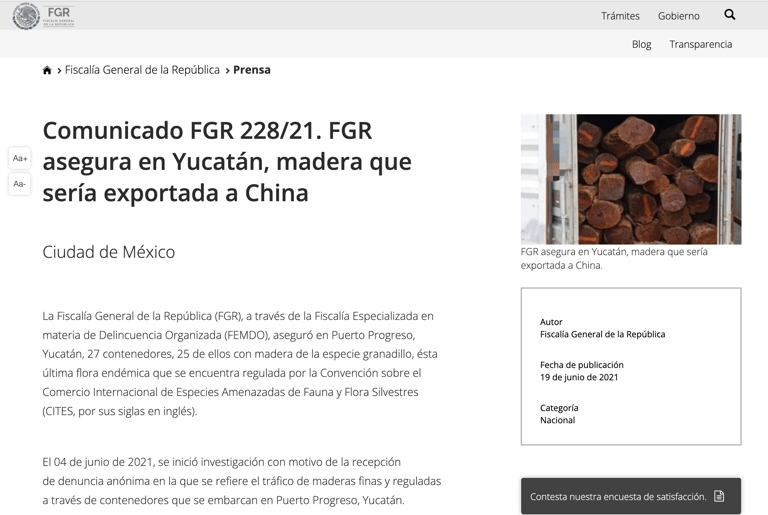
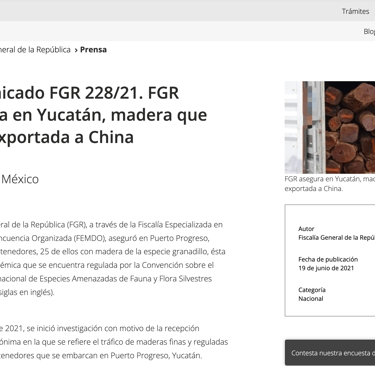
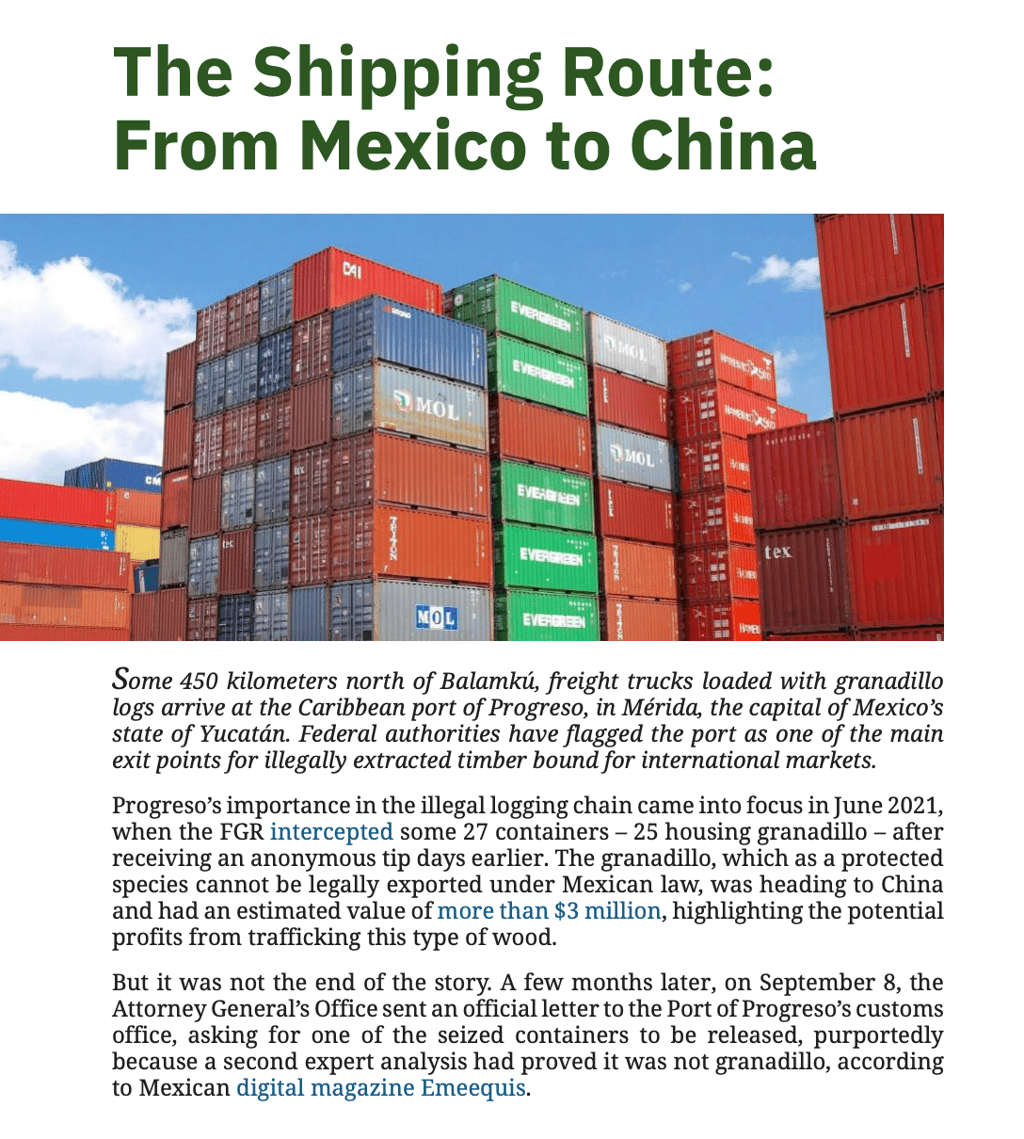
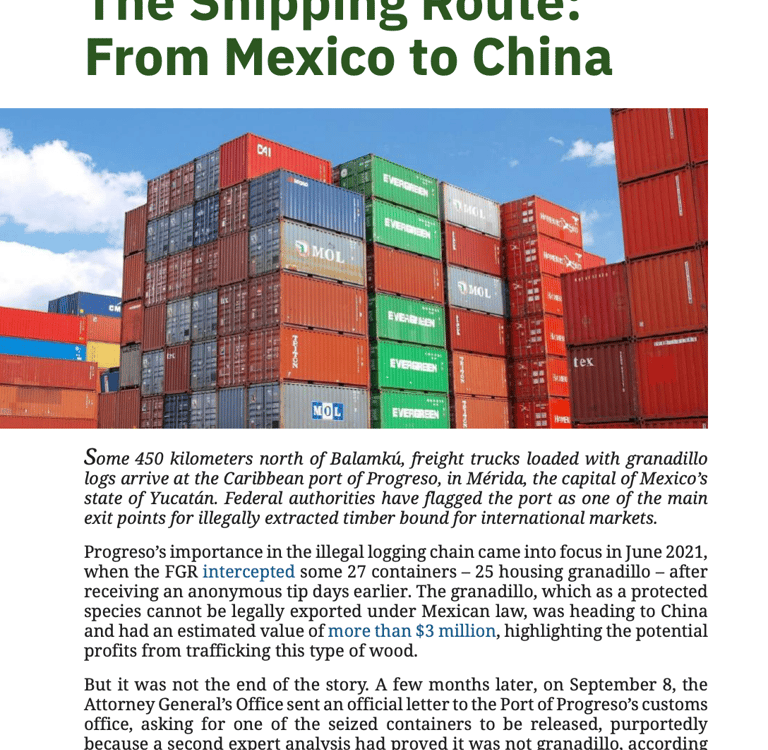
Imagen de reporte Insight Crime (14)
Comunicado FGR 228/21 19 de junio de 2021 (17)
The jungle under armed surveillance
The seriousness of the phenomenon has forced the first line of defense of the Maya Biosphere Reserve to be not the State, but armed civilian groups who risk their lives to protect the Maya Jungle. For more than 30 years, the elite Génesis Group has patrolled the jungle and captured illegal loggers (13), some of whom have stated that they were sent by military commanders, offering bribes to be released, according to an InSight Crime investigation, which also documents the establishment of clandestine sawmills to process the wood in the jungle and camouflage it in order to move it through Mexican ports (14).
Militarization and opacity: the perfect shield
In September 2023, President Andrés Manuel López Obrador decreed the transfer of the Maya Train from FONATUR to SEDENA, under the argument of “national security interest” (15). The effect was immediate: total opacity, impossibility of auditing public resources, and legal shielding for the project’s real beneficiaries. Because the Maya Train is a business—just not for Mexicans. From an initial budget of 120 billion pesos, the project’s cost rose to more than 500 billion. A total of 244 contracts were awarded through direct adjudication for 36,498,665,786 pesos; 67 through restricted invitations to at least three bidders for 6,053,836,450 pesos; 39 contracts between public entities for 8,732,639,837 pesos; and 48 through public bidding for 92,103,566,090 pesos. Among the beneficiary companies are national and foreign consulting firms, construction companies, and corporate groups, as well as global investment funds such as BlackRock and Vanguard. The companies most benefited by the construction of the Maya Train include ICA Constructora, S.A. de C.V.; Operadora CICSA, S.A. de C.V., a subsidiary of Grupo Carso; the Azvindi Ferroviario consortium, S.A. de C.V.; Grupo Indi; and the consortium formed by Mota-Engil México, S.A. de C.V. and the Chinese construction company CCCC (16).
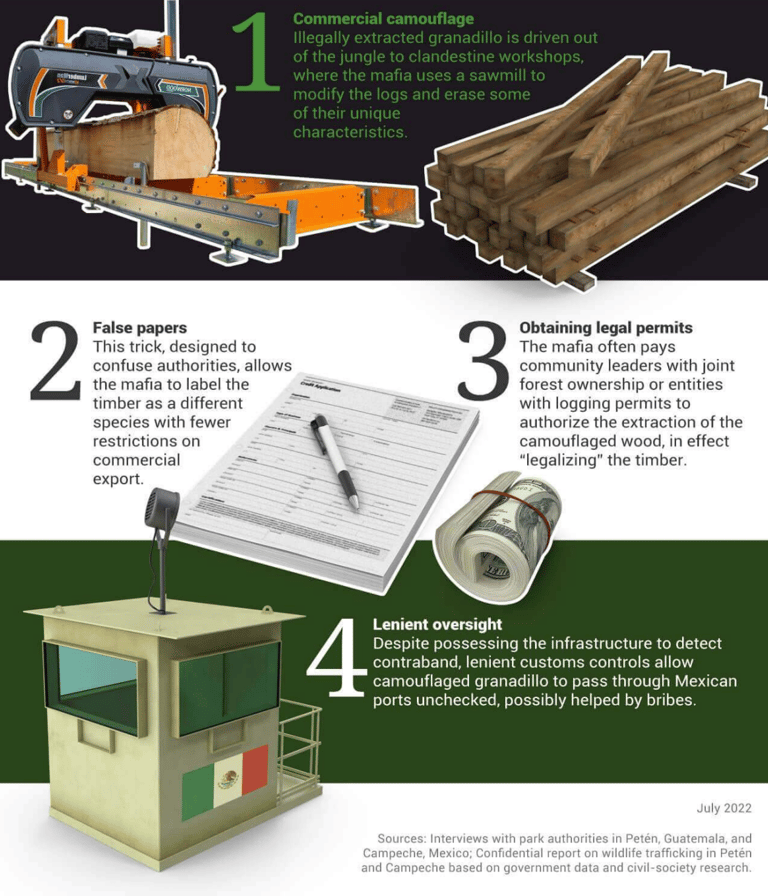
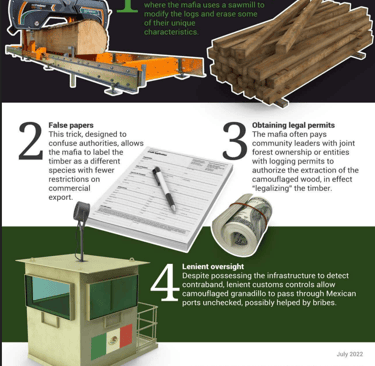
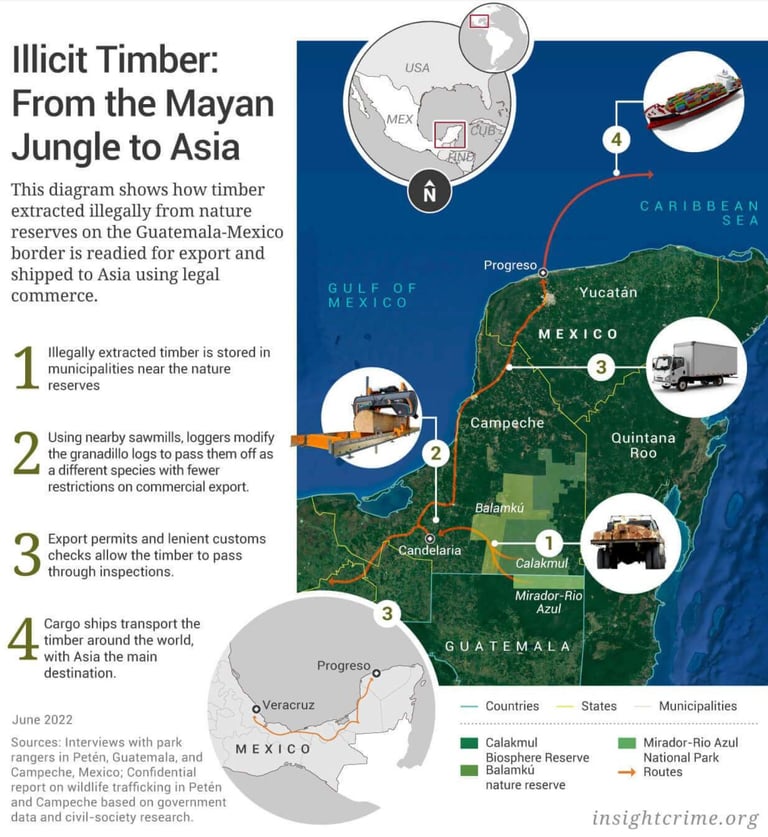
Image of Insight Crime Report (14)
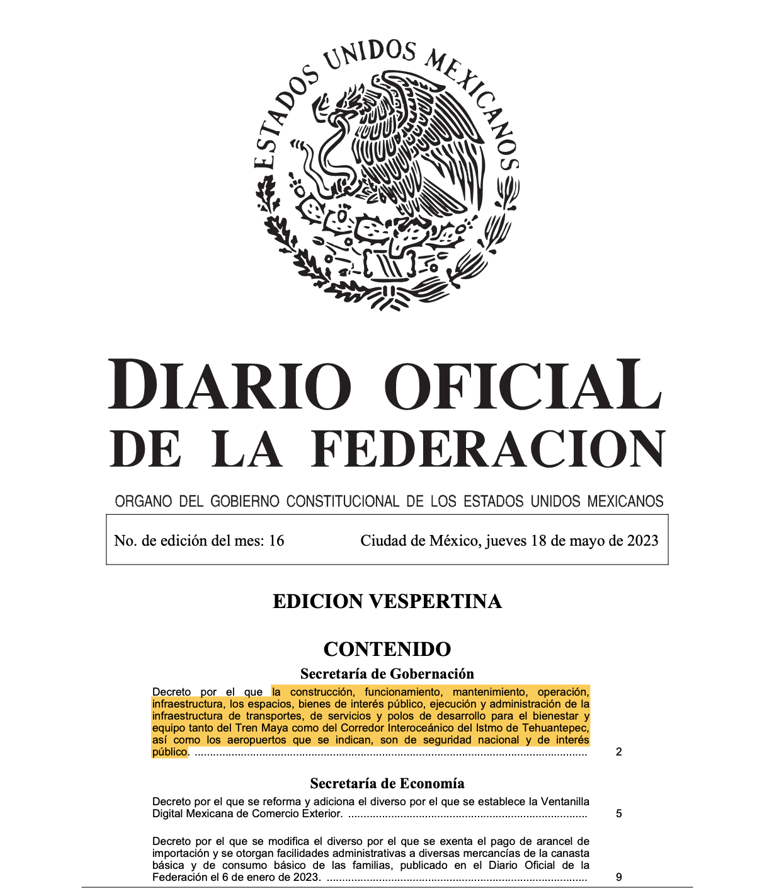
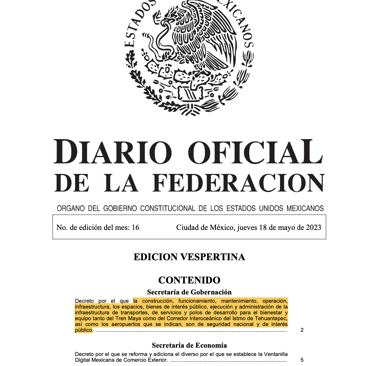
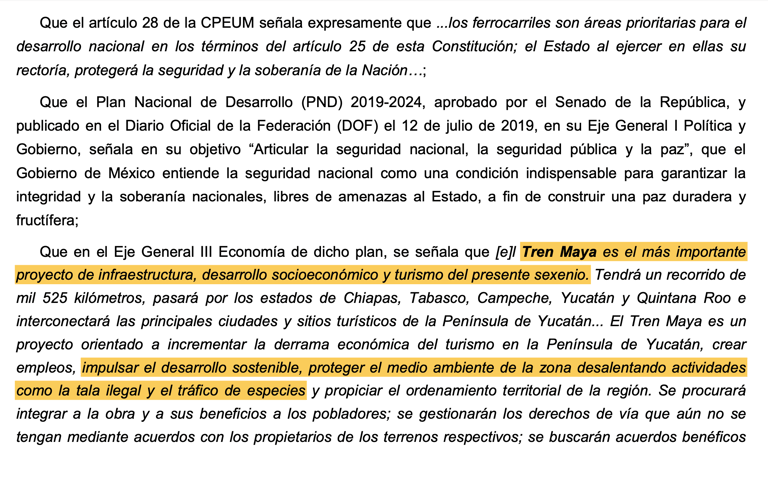
Diario Oficial de la Federación 18th May 2023
The illusion of progress
The plundering of the Maya Jungle did not begin with this administration. Illegal logging, the capture of territory by criminal economies, and environmental corruption are structural evils that predate the Maya Train. But under the administration of Andrés Manuel López Obrador, the Mexican State not only tolerated these dynamics: it accelerated them, normalized them, and shielded them from power.
The Maya Train did not fall upon an empty territory. It was imposed on living jungles, fragile aquifers, communities with memory, and natural reserves protected by law. To make it viable, the State modified routes, fragmented environmental impact assessments, militarized project management, and deliberately closed channels of accountability. In the name of “development,” it handed over the Maya Jungle on a silver platter to economic interests—legal and illegal—that today benefit from disorder, opacity, and devastation.
What is presented to us as national sovereignty is, in practice, a subordinated integration into transnational criminal economies, where natural resources such as timber function as currency within networks of money laundering, illegal trafficking, and institutional corruption. The discourse of progress conceals a more uncomfortable reality: the State has become an active facilitator of organised crime flows, whether through direct action, negligence, or complicity.
The jungle does not disappear on its own. It is destroyed by concrete political decisions, contracts awarded without scrutiny, decrees that turn opacity into the norm, and a development model that conceives nature as an obstacle rather than a limit.
Every tree cut down, every cenote damaged, and every displaced community is the real cost of a project imposed without consensus and without accountability. What is sold to us today as development is plunder. What is presented as sovereignty is criminal dependence.
Image of Insight Crime Report (14)